


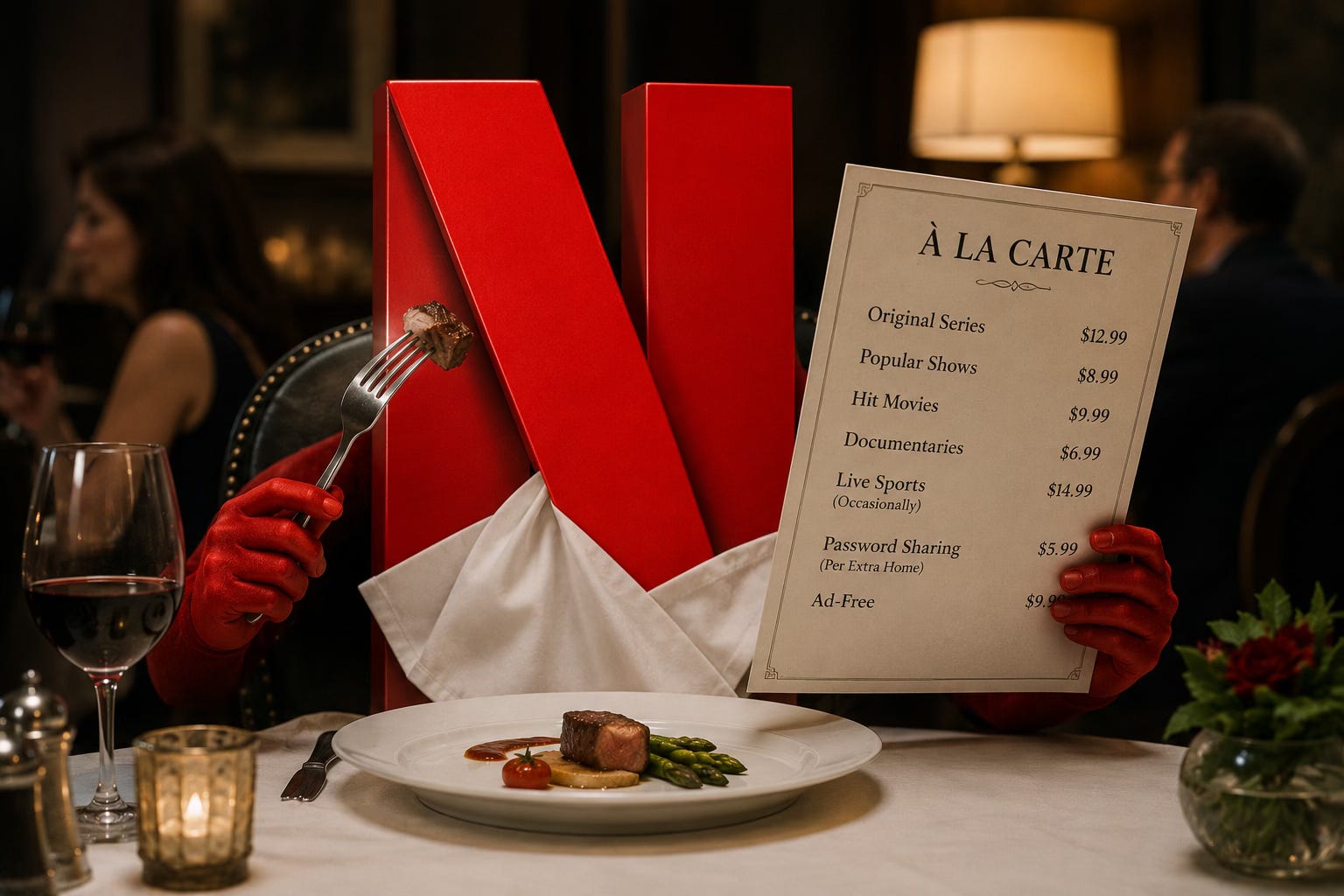
Fox pays $2.2 billion a year for NFL rights. Netflix will reportedly pay around $500 million for its recently expanded slate of games. Fox gets a lot more games – 30 or more to Netflix’s 5 – so you might assume that Netflix’s deal is relatively insignificant compared to Fox. But the low absolute cost of Netflix’s arrangement has huge strategic benefits that are potentially perilous to Fox and the other legacy TV networks.
The NFL is allowing Netflix to order à la carte, so to speak. Netflix is able to cherry-pick premium games (e.g., Thanksgiving Eve, Christmas Day, last day of the regular season), and only buy a handful of them. Fox and the TV networks get traditional full-season packages at a much higher total cost. This is a huge change to how major sports leagues traditionally sold their rights that is not being fully appreciated by the market.
Traditionally, if a broadcaster wanted to air a league’s marquee games/dates, the broadcaster had to step up to an extremely expensive full-season package. Even five years ago, it would have been a non-starter to sell premium games like Christmas Day or Thanksgiving to a broadcast partner not paying “full freight”. But that’s rapidly changing. The leagues are desperate to have the tech companies as buyers of live games, which is allowing the streamers to cut deals for some of the league’s best events at total annual rights fees that are a fraction of those paid by the traditional TV companies.
Said another way, the leagues like the NFL are beginning to allow streamers to extract much or most of the benefits of being an NFL partner without the huge total financial commitment that could eat into the rest of the streamers’ content/business. That’s a big advantage that’s quietly punishing the legacy TV companies’ non-sports business.
The menu
Annual NFL rights / NFL as % of total content budget:
Fox — $2.2B / ~22%
Paramount/CBS — $2.1B / ~14%
Disney (ABC/ESPN) — $2.7B / ~12%
NBC — $2.0B / ~8%
Amazon TNF — $1.0B / ~4.5%
Netflix — $500M / ~2.8%
What each tier is actually buying
The legacy prix fixe package is the full season: 30+ game windows, weekly (or more) full-season studio production, year-round NFL operations infrastructure, playoff rotation including a Super Bowl every four years. The Titans–Cardinals 1pm slot in Week 11 comes with the package whether you want it or not.
The streamer à la carte package is marquee inventory, scaled to fit alongside the rest of the company’s content commitments. Amazon has exclusive Thursday nights and matchups that have gotten better every year — a single premium weekly proposition. Netflix has Christmas Day, which they’ve turned into a brand campaign as much as a sports broadcast. Both get to choose limited premium inventory for maximum eventizing potential. Neither absorbs the huge total cost of a traditional full Sunday (or Monday night) plus playoffs package.
Increasingly streamers buy some cream off the top. Legacy networks pay for the cream and everything underneath it.
The flexibility advantage
Netflix at $500M for the NFL is less than 3% of their ~$20B annual content budget. That leaves the lion’s share for entertainment, films, anime, games, international originals — the actual core subscription drivers of their business. They get the NFL halo, sub retention throughout football season, major advertiser tentpoles for the ad-tier sell, the “Netflix is in sports now” brand positioning. And ~$18B+ left to keep widening the entertainment moat.
Fox at $2.2B is 22% of an estimated $10B content budget. That leaves ~$8B for everything else Fox does — news, scripted, Tubi, non-NFL sports, digital. The NFL spend is fixed, escalating, and load-bearing on Fox’s entire carriage and advertising proposition. And the share of Fox’s money going to the NFL may increase dramatically given that the NFL is reportedly looking to renegotiate Fox’s fees.
This same logic applies to Amazon. Its exclusive Thursday package serves as a major retention tool for Prime Video, and Amazon/Prime Video is able to market and position itself as an NFL partner right alongside the legacy TV companies. But at a total price point and share of its content budget that’s half that of the traditional broadcasters.
Compounding exacerbates the issue. Each year, the absolute gap in non-NFL content spending widens. The NFL isn’t just an inventory cost for Fox — it’s an opportunity cost preventing them from competing across the rest of the content market.
Netflix gets the brand and business benefits of being an NFL partner for ~25% of Fox’s absolute commitment. Amazon gets it for 50%.
The asymmetric risk
Three forces compound against the legacy partners.
Concentration. Fox at 22% of total content spend on one league is the most aggressive single-property concentration in major US media.
A rising price floor. Expanding the buyer set raises every bid in the room. With Amazon and Netflix now in the market, the NFL has every incentive to push all partners — legacy and streaming alike — toward higher prices at the next renewal cycle. The legacy networks will have to absorb those raises with no room to grow into the spend. The streamers can absorb the same increases at the margin without breaking their P&L.
Linear erosion. The NFL deals were underwritten on a carriage and linear ad model that’s structurally weakening. Carriage fees are constrained by distributor margins, which are constrained by cord-cutting. The funding base is shrinking while the commitment rises.
Higher NFL spend, on smaller content budgets, funded by a shrinking carriage stack, with no capacity left to invest in the rest of the business — that’s a one-way ratchet for legacy TV nets.
The close
The NFL’s tiered pricing looks like an expansion of partners. It’s actually a slow squeeze on the legacy networks, who are buying volume at absolute price points that don’t leave room to compete anywhere else. The streamers are signing much smaller commitments, with the bulk of their content budgets free to win the rest of the entertainment market.
In any market with rising input costs and shifting distribution, the partner with optionality wins. The NFL’s best deal isn’t going to the network paying the most.